Content
A 200-bar nitrogen cylinder connected directly to a gas chromatograph is a recipe for erratic readings and unsafe overpressure. A pressure regulator sits between the supply and the process, reducing high inlet pressure to a stable lower outlet pressure. It does this automatically, without electricity, by balancing the force of an adjustable spring against the force created by downstream pressure on a diaphragm or piston.
A pressure regulator is a self-contained control valve that uses downstream pressure as its feedback signal. Every direct-operated regulator has three functional elements:
When outlet pressure drops, the sensing element moves the poppet open. When outlet pressure rises, the sensing element allows the poppet to close. The regulator modulates flow continuously to hold the setpoint.
The best way to understand a regulator is to model it as a force balance. The adjusting knob compresses a spring that pushes down on the diaphragm. Downstream gas pressure pushes up on the same diaphragm. The difference between these two forces controls the position of the poppet.
This is proportional control. Except at lock-up, the poppet is not fully open or fully closed. It holds a throttling position that supplies just enough flow to keep the downstream pressure at the selected value.
Single-stage regulators perform the entire pressure reduction in one step. Their outlet pressure is reasonably stable but can shift when inlet pressure changes, an effect called supply pressure effect. Two-stage regulators use a first stage to drop cylinder pressure to an intermediate level, then a second stage performs the final regulation. This makes the outlet pressure almost independent of cylinder pressure, which is useful for sensitive instruments and high-pressure cylinders.
| Consideration | Single-stage | Two-stage |
|---|---|---|
| Number of reducing stages | One | Two |
| Outlet stability | Good within a modest inlet change | More stable over a wide inlet range |
| Supply pressure effect | Noticeable | Minimal |
| Common uses | Panel systems, general industrial gas control | Laboratory instruments, gas cylinders, precision processes |
| Complexity and cost | Simpler, lower cost | More parts, higher cost |
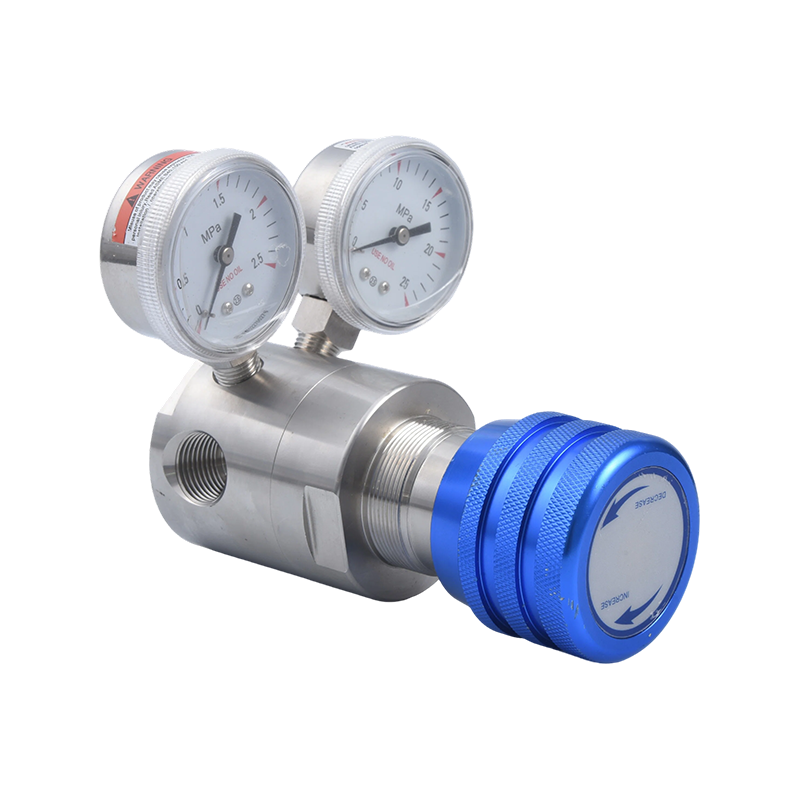
For many stainless steel panel systems, a medium-duty single-stage regulator such as the R57 series medium-sized stainless steel pressure regulator offers a practical balance of flow capacity and control.
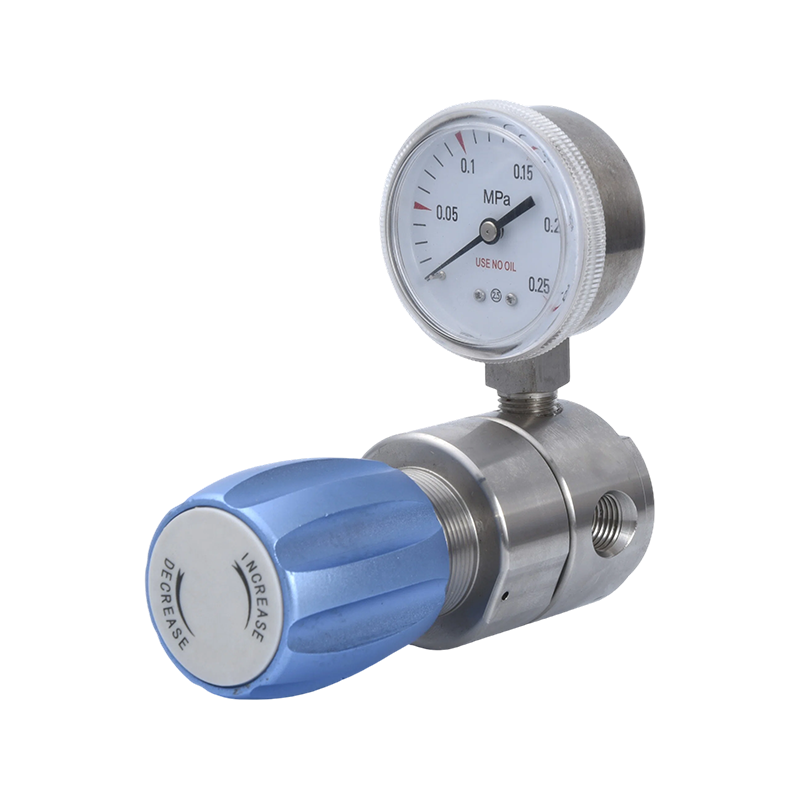 Wholesale R57 Series medium-sized pressure regulator Suppliers, Factory - NingboNingbo Keshengli Stainless Steel Valve Co., Ltd. is China wholesale R57 Series medium-sized pressure regulator Suppliers and Factory,The ...View Product →
When your process requires two-stage stability and visual flow indication, the R19T series two-stage flowmeter-type regulator combines final pressure reduction with a flowmeter in one unit.
Wholesale R19T Series two-stage flowmeter-type pressure regulator Suppliers, FacNingbo Keshengli Stainless Steel Valve Co., Ltd. is China wholesale R19T Series two-stage flowmeter-type pressure regulator Suppliers and...View Product →A pressure-reducing regulator controls downstream pressure. A back-pressure regulator controls upstream pressure by opening a relief path when the inlet pressure exceeds the setpoint. Back-pressure regulators are used in gas mixing systems, chemical vapor delivery, and sparging applications where a constant pressure must be maintained ahead of a valve or filter.
In a stainless steel gas system, a dedicated stainless steel back-pressure regulator such as the SR7 series stainless steel back-pressure regulator applies the same force balance principle in reverse: the spring holds the valve closed until upstream pressure overcomes it.
Wholesale SR7 Series stainless steel back pressure valve Suppliers, Factory - NiNingbo Keshengli Stainless Steel Valve Co., Ltd. is China wholesale SR7 Series stainless steel back pressure valve Suppliers and Factory,...View Product →
For very large process flows, pilot-operated regulators use a small pilot regulator to amplify the sensing signal. They are less common in compact instrumentation tubing but become valuable when the required flow capacity grows.
Start with the fluid, pressure range, and flow. For corrosive, high-purity, or hydrogen service, 316L stainless steel is a robust default. Verify the inlet pressure rating, outlet pressure range, and flow capacity at the operating setpoint. Also consider the connection type: compression tube fittings, VCR face seals, or welded ends. For a complete line of stainless steel pressure regulators, review the NB-KSL stainless steel pressure regulator range.
The two performance numbers that matter most are droop and lock-up. Droop is the decline in outlet pressure as flow increases. Lock-up is the rise above setpoint when flow stops. A well-designed regulator keeps both small, and a two-stage design usually delivers better performance when the inlet pressure changes widely.
If this is a new installation, follow the flow direction arrow, secure the inlet tubing, and avoid mounting the regulator near strong vibration. NB-KSL’s installation instructions explain torque, alignment, and leak-testing recommendations in detail.
Understanding how a pressure regulator works is mostly about understanding force balance. Once you can trace the spring force against the diaphragm force, you can predict why a regulator opens on demand, closes on dead-end, and behaves differently in single-stage and two-stage configurations. Choose the right material and connection type, respect the flow limits, and the regulator will quietly keep your gas system under control.
Stainless Steel Pressure Regulators Deliver Superior Safety and Precision in Gas Control Stainless steel pressure regulators are the industry standard for controlling gas flow safely and accurately across critical applications, from semico...
What Stainless Steel Needle Valves Are and How They Work A needle valve controls flow through a small-bore orifice by advancing or retracting a tapered needle-shaped stem into and out of a precision-machined seat. As the handwheel or actua...
A process engineer once asked me why a new 3/8-inch needle valve could not hold downstream pressure. The valve was not defective; it was oversized. Every small turn of the stem moved more flow than the process needed, and the Cv formula wo...
If you only remember one thing from this guide, remember this: for most hydrogen systems operating between 350 and 700 bar, 316/316L stainless steel fittings with metal-to-metal or PTFE-based seals are the safest and most cost-effective cho...
 1 Zhongxin Yungu Zone D Building 1, Jiangkou Street, Fenghua District, Ningbo City, Zhejiang Province, China
 +86-574-88561893 / +86-15057497901
 Copyright © Ningbo Keshengli Stainless Steel Valve Co., Ltd. Rights Reserved.
Wholesale Stainless Steel Fittings & Valves Manufacturers
Copyright © Ningbo Keshengli Stainless Steel Valve Co., Ltd. Rights Reserved.
Wholesale Stainless Steel Fittings & Valves Manufacturers



 English
 中文简体
中文简体